
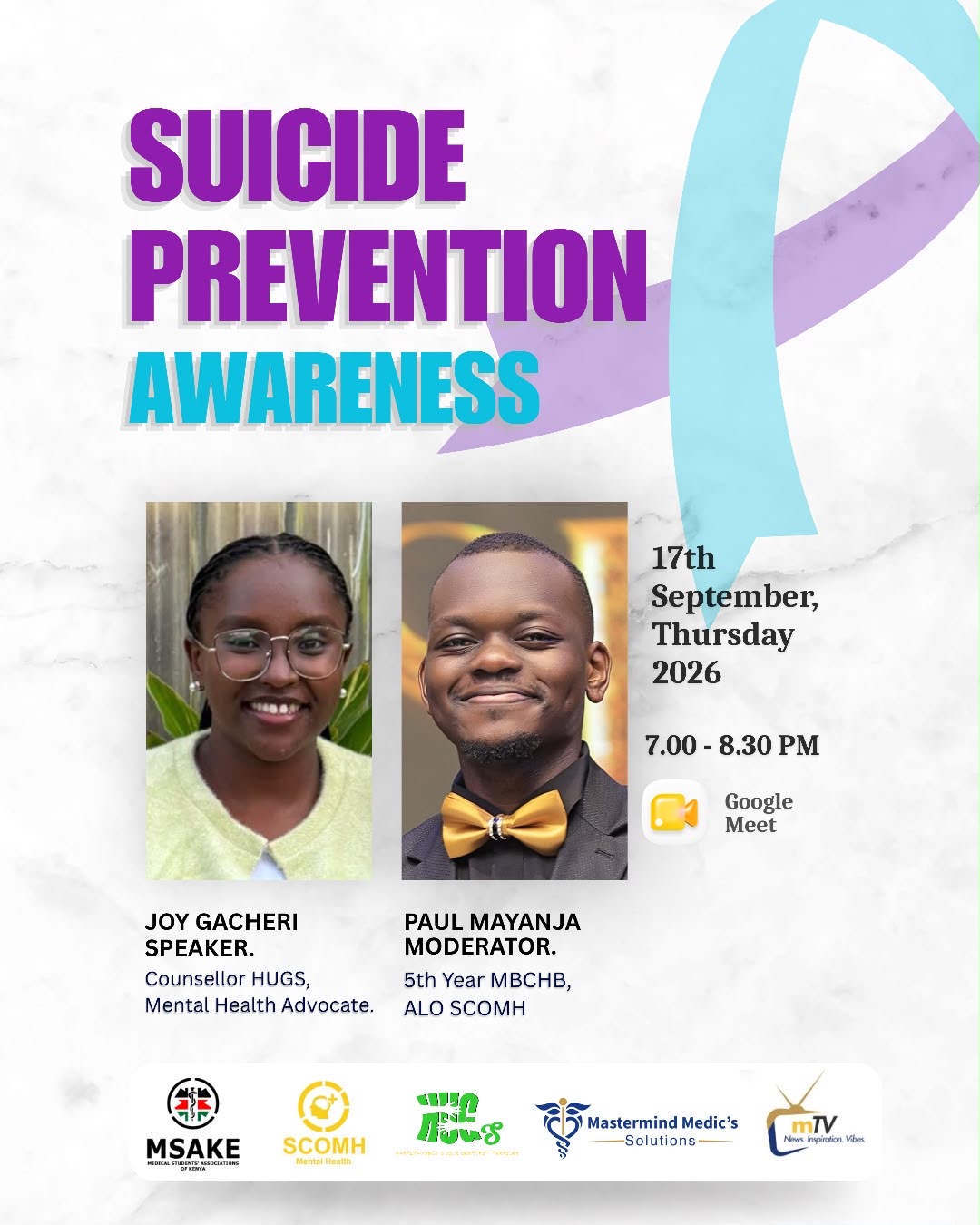
In a critical effort to foster mental health awareness, the Standing Committee on Mental Health (SCOMH) at the University of Nairobi (UoN), under the Medical Students Association of Kenya and in collaboration with HUGS Organization, recently hosted a suicide prevention webinar on 17th September, to sensitize members of the UoN student body to champion Suicide prevention.
With the world observing the month of September as the Suicide Prevention Month, the session shed light on statistics, warning signs and how to respond to someone in crisis.
According to Kenya Medical Research Institute (KEMRI), Kenya averages a total of 4 suicide deaths a day and an average of 470 cases of attempted suicide reported to the police. The real numbers are likely much higher due to underreporting. Furthermore, there are 700,000 suicide deaths reported per year globally and 14 million reports of attempted suicide.
The session, moderated by UoN-FHS 5th-year medical student Paul Mayanja, featured speaker Joy Gacheri, a counsellor and mental health advocate from HUGS, who provided essential insights into identifying and responding to suicidal crises.
According to Joy Gacheri, suicide which is the 3rd leading cause of death for 15-29 year olds is driven by different factors like; depression, bipolar, substance use - trauma or abuse, bullying, loss of a relationship, job or school place, chronic pain or illness, financial stress, isolation or a suicide in the family or friend group.
The webinar also addressed the gravity of global and local suicide statistics which are affected by a number of barriers such as, stigma and past criminalization which kept deaths caused by suicide to go unreported.
The conversation highlighted a landmark legal shift where on January 9, 2025, the High Court declared the criminalization of suicide attempts unconstitutional. This ruling, which protects the rights to dignity and health, marks a move away from punishing those in crisis and toward providing medical and psychological support.
Gacheri guided participants through the spectrum of suicidal ideation—ranging from passive thoughts of non-existence to active plans and intent. She emphasized the importance of language, advocating for the term "died by suicide" rather than "committed suicide" to reduce stigma. Attendees were taught to recognize warning signs, such as social withdrawal, giving away possessions, and expressions of hopelessness, as well as the distinction between self-harm as a coping mechanism and an active intent to die.
According to the speaker, information on mental health is also important in the journey of suicide prevention especially for those planning on ending their lives.
“When you have information in regards to your mental health, it’s very important, it helps you know well, these are my triggers and this is what works for me,” she said.
The core of the session focused on the "Ask, Listen, Connect" framework. Gacheri urged participants to ask directly about suicidal thoughts without fear of "planting the idea," to listen without judgment, and to connect individuals with professional help.
"You don't need the perfect words. You just need to notice, ask, and stay," Gacheri remarked.
The webinar concluded with practical coping strategies, such as creating safety plans and utilizing grounding techniques such as taking part in activities that will distract their minds from suicidal thoughts and delay any self-harming actions. Potential victims were also cautioned against secrecy as it feeds suicidal thoughts.
“Secrecy feeds it, one honest conversation changes the weight of the thing you’re carrying. Slow breathing, the 5-4-3-2-1 relaxes the senses exercise, moving your body, getting outside for ten minutes helps,” said Gacheri.
Emergency resources, including Befrienders Kenya and Childline Kenya, were provided to ensure that those in need have immediate avenues for support.
UoN students can also reach the following contacts in regard to mental health assistance;
UoN counselling services email- counselor@uonbi.ac.ke
Call; 0204918114, 2nd Floor UoN Towers.
- Log in to post comments


