
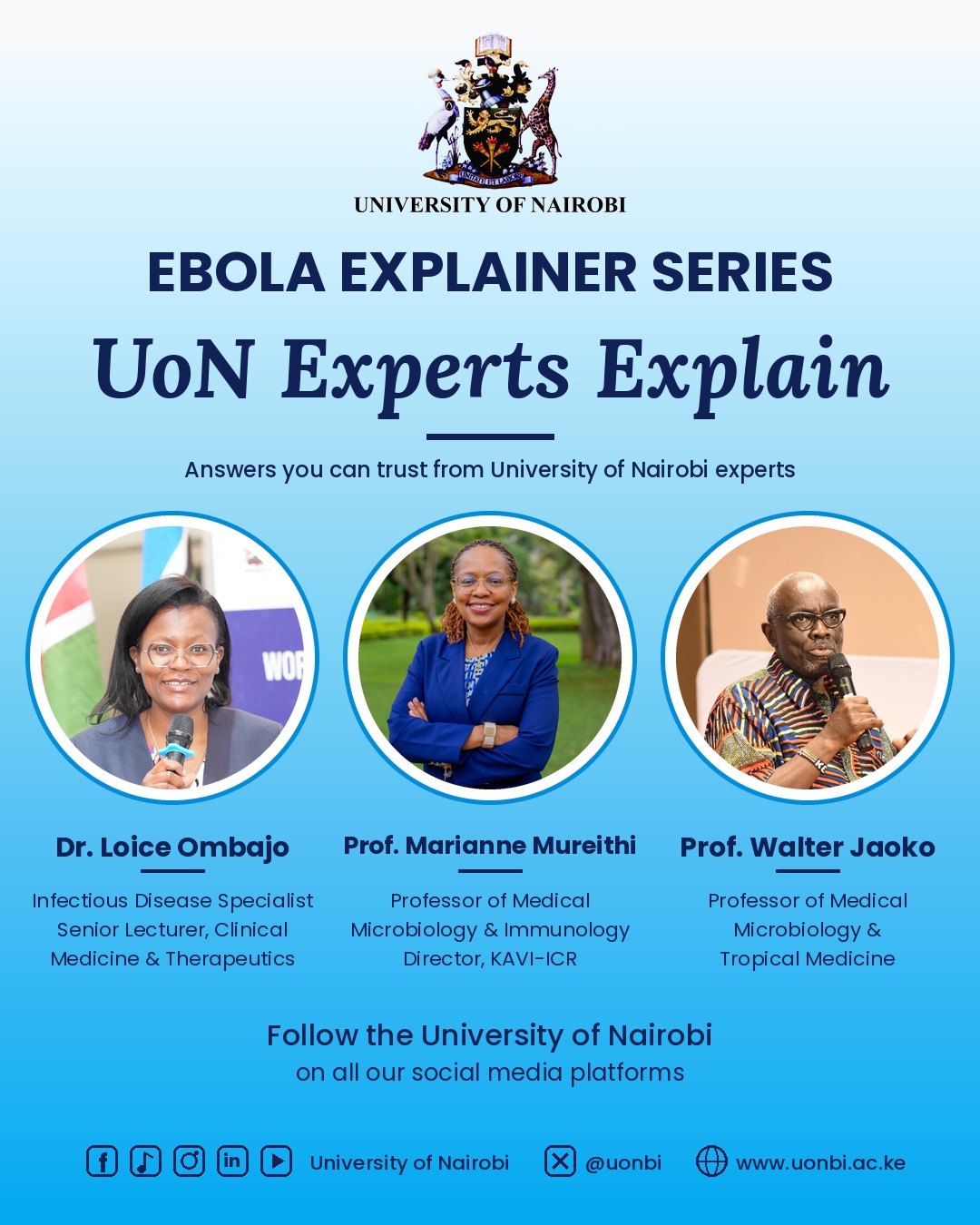
As Ebola remains a public health concern, experts from the University of Nairobi have provided essential clarity on Ebola, a deadly viral hemorrhagic fever. Drawing on insights from Faculty of Health’s Dr. Loice Ombajo, Prof. Jaoko Walter, and Prof. Marianne Mureithi, these experts break down everything the public needs to know to stay safe.
In the previous weeks Kenya has experienced a few cases of Ebola virus which is a viral disease, in Kenya we have experienced cases of the strain of Ebola called of Bindibugyo virus that was also reported in parts of Uganda and the Democratic Republic of Congo.
In providing her expert opinion on the symptoms and detection of Ebola virus, Dr. Ombajo noted that initial signs of Ebola such as fever, fatigue, muscle pain, diarrhea, and vomiting-closely resemble common illnesses like malaria.
She urged the public to be vigilant of such symptoms and seek appropriate medical intervention to asses if it’s the Ebola virus so that prompt adequate measures are taken.
‘‘Initial presentation of the virus are similar to common infections things like fever like malaria, things that cause diarrhea and vomiting, so if there’s an unexplained febrile illness particularly in individuals who’ve traveled or had contact with people with Ebola, they should undertake testing,’’ she stated.
Prof. Jaoko reiterated this further emphasizing that because these symptoms are so general, medical professionals must maintain a "high index of suspicion.
‘‘One of the greatest challenges in managing Ebola is that early symptoms are non-specific, while bleeding is a characteristic sign of the virus, it often appears later in the disease progression,” Prof. Jaoko stated.
Speaking on the transmission and diagnosis, the experts highlighted the major ways that the deadly virus spreads and this is through direct contact with the bodily fluids of an infected person, including through breastfeeding and semen.
To diagnose a case, health officials look for two critical links: an epidemiological link which is informed by if a person has had recent travel to an active outbreak zone or contact with an infected individual. The other link that informs diagnosis is evidence of clinical symptoms where someone who has an epi link has symptoms or fever, diarrhea and vomiting fatigue and muscle pain.
According to Dr. Ombajo, symptoms alone do not confirm Ebola. These links provide important information that health professionals need to assess to inform the appropriate steps taken.
With Ebola virus being a deadly virus, testing requires strict protocols and specialized facilities. Prof. Jaoko warned individuals to undertake testing at the appropriate sanctioned healthcare facilities stating, ‘‘it’s not just any lab that can do the tests for Ebola, sample collection is very strict there are reference labs that collect and screen the samples.”
In Kenya samples are processed in high-security biosafety labs, such as the National Public Health Institute, labs at KEMRI, labs at KEMRI CDC in Kisumu and a few mobile labs at the border with Uganda
Treatment is primarily supportive, focusing on fluid replacement to combat dehydration from vomiting and diarrhea. Additionally, investigational therapies like monoclonal antibodies and the antiviral Remdesivir are utilized.
The experts also advised the public on prevention measures taken to prevent infection and spread of the deadly virus, citing personal and community responsibility measures to be undertaken.
‘‘Early intervention is life-saving. In the DRC, mortality rates have reached 48%, but these can be lowered if we consider early presentation and making sure that units are ready in the country to offer appropriate treatment to people with Ebola,’’ Dr. Loice stated.
Prof. Marianne urged the public to follow Ministry of Health guidelines by practicing frequent handwashing, minimizing physical contact like handshaking or kissing during outbreaks, and reporting any mysterious symptoms or recent travel history immediately via the toll-free number 719.
Combating the spread of Ebola virus also requires access to the right information. The experts highlighted the need of curbing misinformation, as false reports can cause people to lower their guard and ignore lifesaving precautions.
- Log in to post comments


