
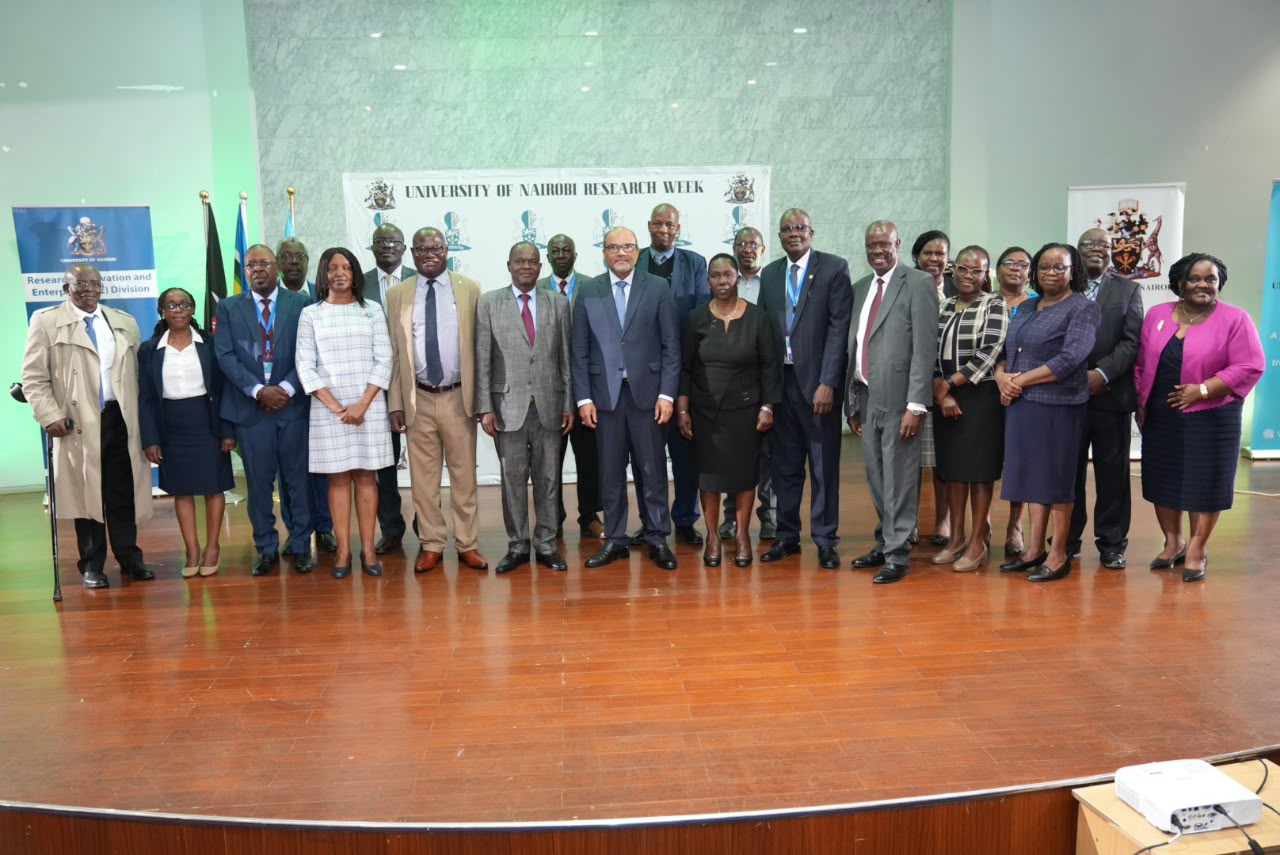
PS State Department for Science, Research and Innovation, Prof. Shaukat Abdulrazak, VC Prof. Ayub Gitau and UoN top administration pose for a photo at the Opening Ceremony of UoN Research Week at Chandaria Auditorium.
A call to bridge the gap between scientific discovery and community impact, urging a shift toward research that addresses domestic challenges and drives the nation towards development has been made to researchers and academics at the University of Nairobi at this year’s Research Week.
Speaking during the Research Week Opening Ceremony held on the 21st October, 2026, Faculty of Health Sciences own and Director of the KAVI Institute of Research, Prof. Marianne Mureithi, underscored the need for researchers and institutions of higher learning to take up the challenge to use research and innovation to solve Kenyan and African issues at large.
“My ask, and for all the researchers here, is to have these research plans coming to us so that you cannot just compete for the funds, but change the research questions, that is advised or driven by African people. As Kenya and Africa we have to lead our science,’’ Prof. Mureithi said in her address at the event.
Prof. Mureithi further highlighted UoN’s global standing, noting the institution's historical role in Ebola vaccine research. "We shouldn't be responding when the problem is already there, but before it arrives," she further stated, emphasizing the need for researchers to use their expertise to mitigate issues affecting the African people.
The Principal Secretary, State Department for Science, Research and Innovation, Prof. Shaukat Abdulrazak, who was the Chief Guest reiterated this message and challenged UoN and other institutions to tap into research and innovation to solve the country’s problems.
PS Prof. Abdulrazak also underscored the need for collaboration within the government, institutions of higher learning and the private sector to realize this, prompting a call for institutions to create a research ecosystem that connects with the private sector to solve contemporary issues in housing, agriculture, and local manufacturing in the healthcare sector. He noted that Kenya’s transformation depends on its human resources, competent personnel who can use innovation to drive the country toward a position beyond Vision 2030.
“Transformation starts with the people, not just resources. Intellectuals and the private sector should bridge the gap between research and real-world solutions. We are the cream of the society we are the learned, we have the solutions to solve the problems affecting us. Without the knowledge that is innovative based we can’t move forward,’’ he stated in his keynote address.
In his address at the event UoN VC Prof. Ayub Gitau commended the student body for upholding the institutions commitment to research, innovation and academic excellence stating that students make up the bulk of the research publications.
He also commended the research institutions like KAVI for their contributions in research and innovation.
The event also featured a Conference by UoN’s Center for Epidemiological Modelling and Analysis (CEMA-Africa) that had critical panel on Artificial Intelligence (AI) and emerging technologies.
Experts discussed how emerging technologies like AI fit into research and exploring how students and researchers are adapting to these new capabilities and technologies. The forum highlighted the pros and cons of AI in learning and research noting that while it reduces costs and improves experimentation, it introduces challenges regarding trust and academic integrity.
Panelists, including Prof. Waiganjo Wagasha a UoN Computer Science Professor and CEMA PHD Fellow Dr. Oumaima Laraj, emphasized that AI should be a tool to supplement research and learning rather than a replacement for critical thinking.
“AI is a tool, not a replacement for human intelligence. Researchers must use AI critically and responsibly, learning when to deploy it, how to evaluate its outputs, and most importantly, how to scientifically validate every result,” Dr. Laraj advised.
The forum concluded with a call for institutions of higher learning to rapidly update the curriculum to include emerging technologies like AI, ensuring graduates are not left behind in the changing learning and market space and are equipped to use AI in their learning and to further lead in the global AI space to enable Kenya to jump into the future.
- Log in to post comments


