
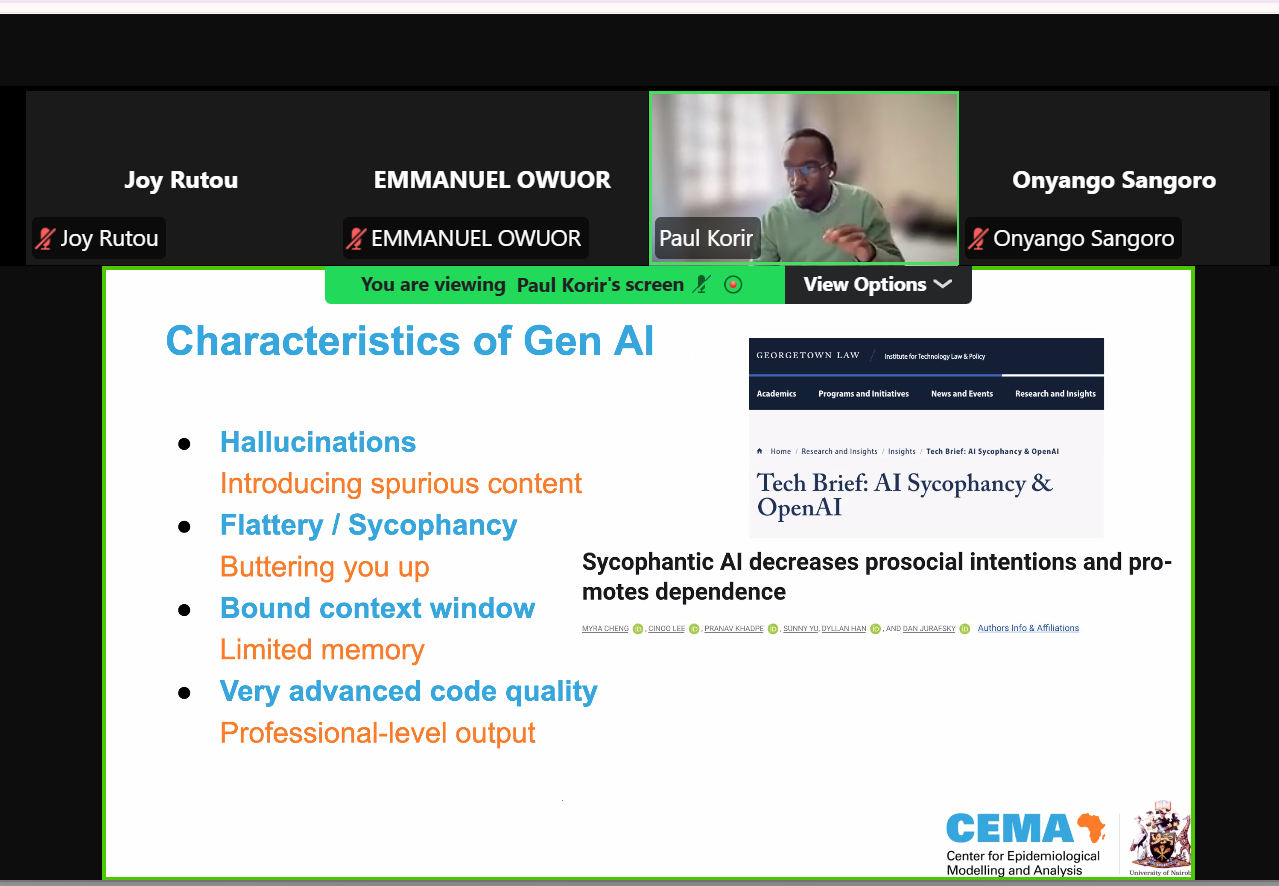
Dr. Paul Korir speaking at the virtual seminar.
In a thought-provoking seminar, Dr. Paul Korir, a Senior Research Fellow in Software Engineering and AI at the Center for Epidemiological Modelling and Analysis (CEMA), highlighted the vital role of software in modern scientific research.
The virtual seminar held on 10th June 2026 titled "Science Runs on Software," underscored how software and AI are transforming scientific research.
The session highlighted how scientific computing has evolved into a crucial third pillar of knowledge that is used to advance science and research.
Dr. Korir explained that scientific computing, the use of numerical simulators powered by computational machinery, is now central to research across diverse fields. He highlighted its potential as an engine for growth and advancement, particularly in Africa, while noting the continent's current lag in this critical infrastructure.
“Scientific computing is a big opportunity for Africa as it fits in with the visions for African advancement like the Science, Technology and Innovation Strategy for Africa (STISA) 2034,” he stated.
The seminar also delved into the relatively new field of Research Software Engineering (RSE), a discipline that merges professional software development skills with a deep understanding of research.
In his presentation Dr. Korrir stated the diverseness of RSE applications which span science, engineering, arts, social sciences, climate, and health.
The session also touched on the impact of generative artificial intelligence (AI) on research. Dr. Korir detailed how AI is revolutionizing learning through personalized tutoring, transforming writing, reshaping information retrieval and coding behaviors where AI is breaking down programming language barriers.
Dr. Korrir further went on to expound on AI characteristics including "hallucinations" (spurious content), sycophancy, limited context windows, and the need for rigorous testing to ensure code quality and prevent drift.
He then called on AI users to use generative AI responsibly in research.
“Generative AI has rewritten the rules and it’s our role to adapt. Using AI naively without thinking will impair ability to think and impair the user’s ability to think and learn,” he added.
Dr. Korir concluded by offering five practical tips for responsibly integrating generative AI into Research Software Engineering, emphasizing adversarial personalization prompts to combat hallucinations and flattery of AI, mastering fundamentals, rigorous testing, exploring agentic coding tools to be able to fully take advantage of AI tools, and elevating usability to meet user needs.
- Log in to post comments


