
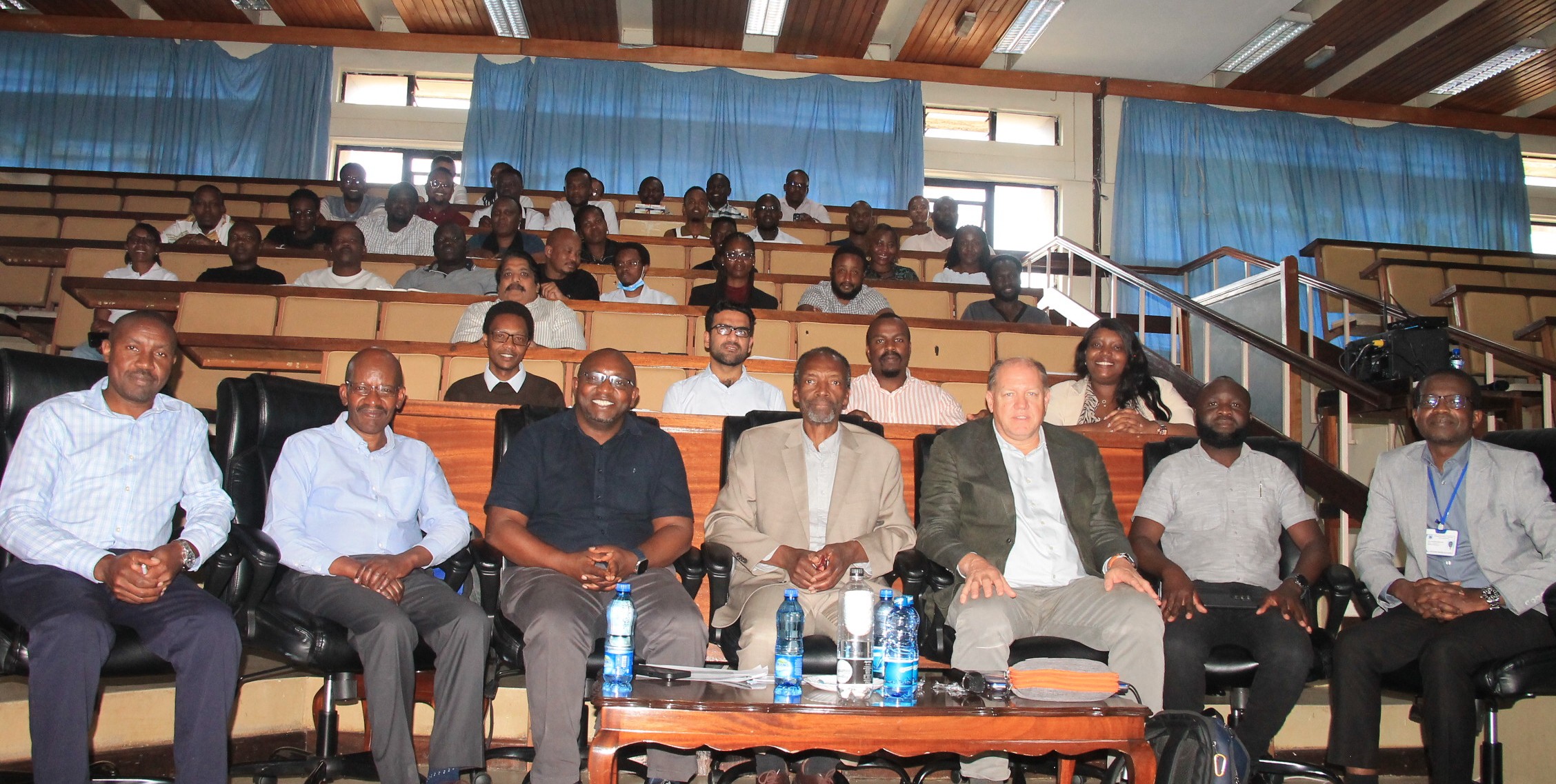
Group picture at the Orthopedic Oncology Seminar at UoN-KHN Campus.
The Faculty of Health Sciences hosted the Orthopedic Oncology Seminar on 28th August 2026, which brought together leading surgeons, specialists and residents to discuss the complexities of musculoskeletal oncology which is a highly specialized field of medicine that focuses on the diagnosis and treatment of tumors affecting the bone.
The seminar covered vital concepts of bone cancer from epidemiology, malignancy, treatment and control, case studies and socioeconomic issues surrounding this field of medicine.
Speaking at the seminar, Dr. Geoffrey Rotich an Oncology and Trauma Surgeon from Moi University, covered the core concepts of bone cancer highlighting that primary bone cancer is rare, accounting for less than 0.2% of all malignancies, though benign tumors are more common. He detailed age-related presentation peaks, predominance and incidence of the condition.
The discussions also revolved around identifying key "red flags" for bone tumors which included night pain, progressive bone pain, palpable masses, pathological fractures, restricted movement, and systemic signs like fatigue or fever. The warning signs for soft tissue tumors highlighted included, concerning features are size over 5cm, being deep to fascia, growing or changing, pain, and a firm or fixed texture.
Dr. Rotich further emphasized the need to investigate any unexplained growing mass stating, “Sarcomas don’t read textbooks so you just never assume that’s the importance of doing a biopsy.”
His sentiments were further emphasized by key speaker Dr. Dancun Whitwell an Orthopedic and Trauma Surgeon from Oxford University, who reiterated the critical role of biopsy in diagnosing sarcomas, with a strong caution against assuming a diagnosis.
Dr. Nicholas Okumu an Orthopedic Surgeon from KNH stressed the importance of early referrals and timely limb salvage for better outcomes, noting that the "post-chemo era" has significantly improved survival rates through early diagnosis and chemotherapy, leading to limb salvage surgery rather than amputation.
Dr. Nick Were advocated for technological advancements to improve patient care, citing high cost of cancer care as a barrier for patients to receive this vital healthcare.
“We should look more into technology to better the care we give patients and to also lower the cost burden on them,” said Dr. Nick Were.
Dr. Vincent Mutiso an Orthopedic Surgeon from UoN, reiterated his sentiments highlighting the need for advocacy and government engagement due to the high cost of cancer care.
Discussions on metastatic bone disease by Dr. Mwangi and limb salvage options by Prof. Lectary Lelei underscored that the decision for limb salvage depends on tumor location, patient factors, and available resources, with the ultimate goal being to remove the tumor while preserving the patient's wholeness.
“The art of limb salvage lies in removing only what is necessary so that the tumor is gone, but the person remains as whole as possible," Prof. Lelei said in his presentation.
The seminar provided the residents with a foundational understanding of concepts and principles in musculoskeletal oncology.
- Log in to post comments


