
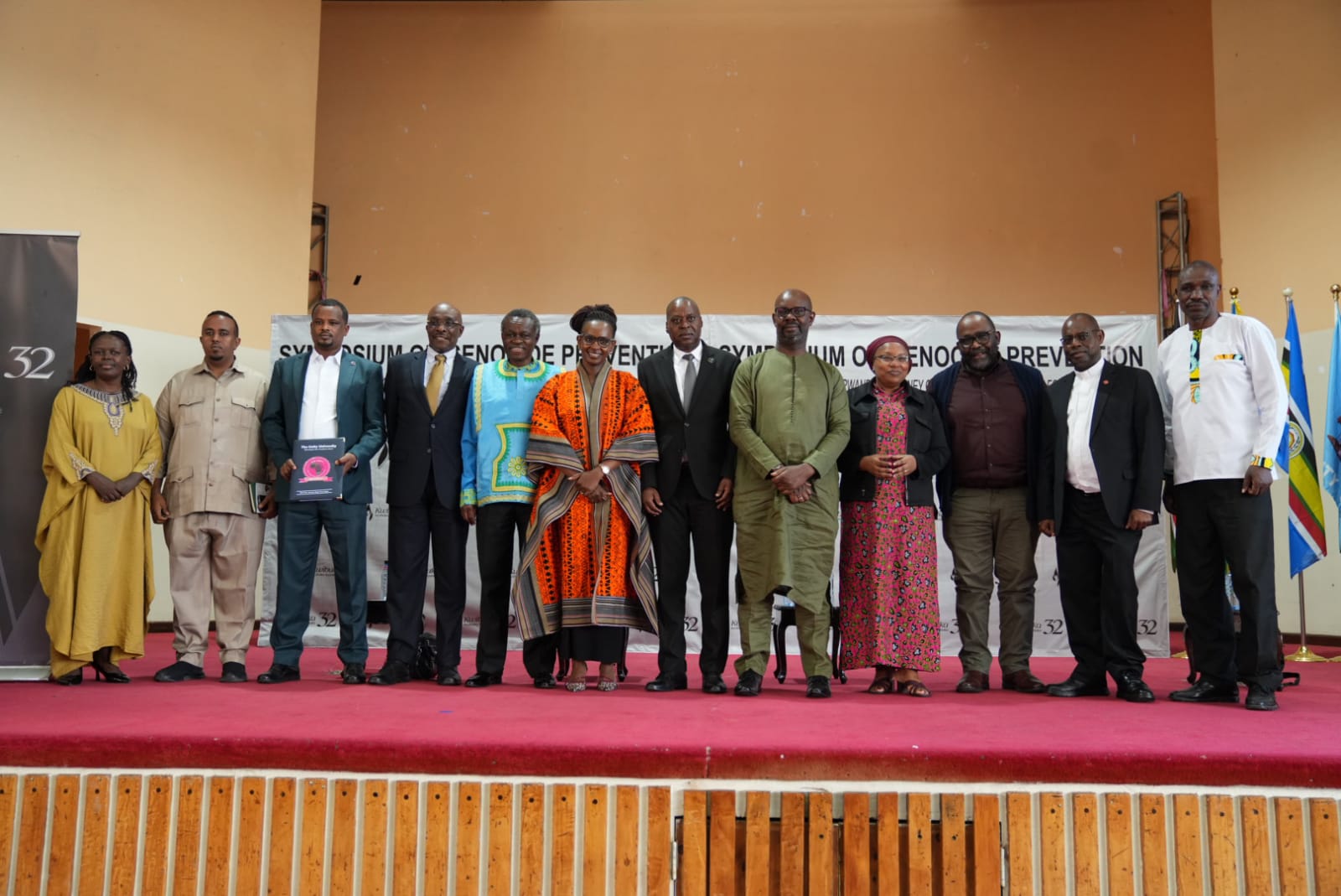
Ambassador Ernest Rwamucyo, the High Commissioner of Rwanda to Kenya flanked by Prof. PLO Lumumba, Senator Sylvia Kassanga and panel members who spoke at the Symposium on genocide at UoN on 22nd April 2026.
In marking 32 years from the infamous Tutsi genocide in Rwanda, the University of Nairobi (UoN) hosted a symposium on genocide prevention on 22nd April 2026.
The event served as a profound reflection on Rwanda's remarkable journey of renewal, underscoring Africa's collective dedication to avoid another genocide.
Distinguished scholars, survivors, and policymakers gathered to discuss the Rwandan Tutsi genocide, sharing critical insights of the historical evil. The symposium highlighted the enduring spirit of the Rwandan people, whose path from unimaginable tragedy to national healing offered a beacon of hope and acted as a reminder of the devastating consequences of the hatred fueled genocide.
The discussions underscored the vital importance of prevention strategies, emphasizing education, justice, and the cultivation of inclusive societies.
Speaking at the event, Prof. PLO Lumumba lauded Rwanda's extraordinary transformation and advancement, attributing its success to the leadership of President Paul Kagame. Lumumba used Kigali as a prime example of a city embodying order, boasting modern infrastructure, and embracing technological progress.
His address concluded with a resounding message of resilience and optimism. Prof. Lumumba firmly stated that denialism and revisionism will not succeed in distorting historical truths.
“The struggle continues against denialism and purporting genocides and things that makes us forget,” he added in his address.
Fr. Elisee Rutagambwa a survivor of the Rwandan Tutsi genocide, faulted the international community for its delayed response to the genocide and eventual withdrawal.
“The genocide in Rwanda against the Tutsi people teaches us a lesson. The international community did not simply fail, but it also arrived too late in every stage and in doing so allowed the genocide to continue,” he lamented.
He further pointed out that this enabled execution, prolonged the killings and acted as a structural enabler of the genocide.
Ambassador Ernest Rwamucyo, the High Commissioner of Rwanda to Kenya, in his address termed the transformation of Rwanda after the genocide as a continuous and progressive process that did not happen overnight.
“The transformation reminds us that prevention is not only about stopping violence but also about building societies that are inclusive, just and resilient,” he further added.
The journey to ensure that such a tragedy is not repeated requires collective effort and very practical commitments to ensure history is also not denied but preserved with dignity and truthfully according to Senator Sylvia Kassanga, who represented the Pan-African Institute and Lukenya University.
She also highlighted the need to educate young Africans to recognize early warning signs of conflict and division through supporting research and documentation.
The overall message of the symposium was clear: the commitment to preventing future genocides is a necessary call to action for the African continent and the global community.
- Log in to post comments


