
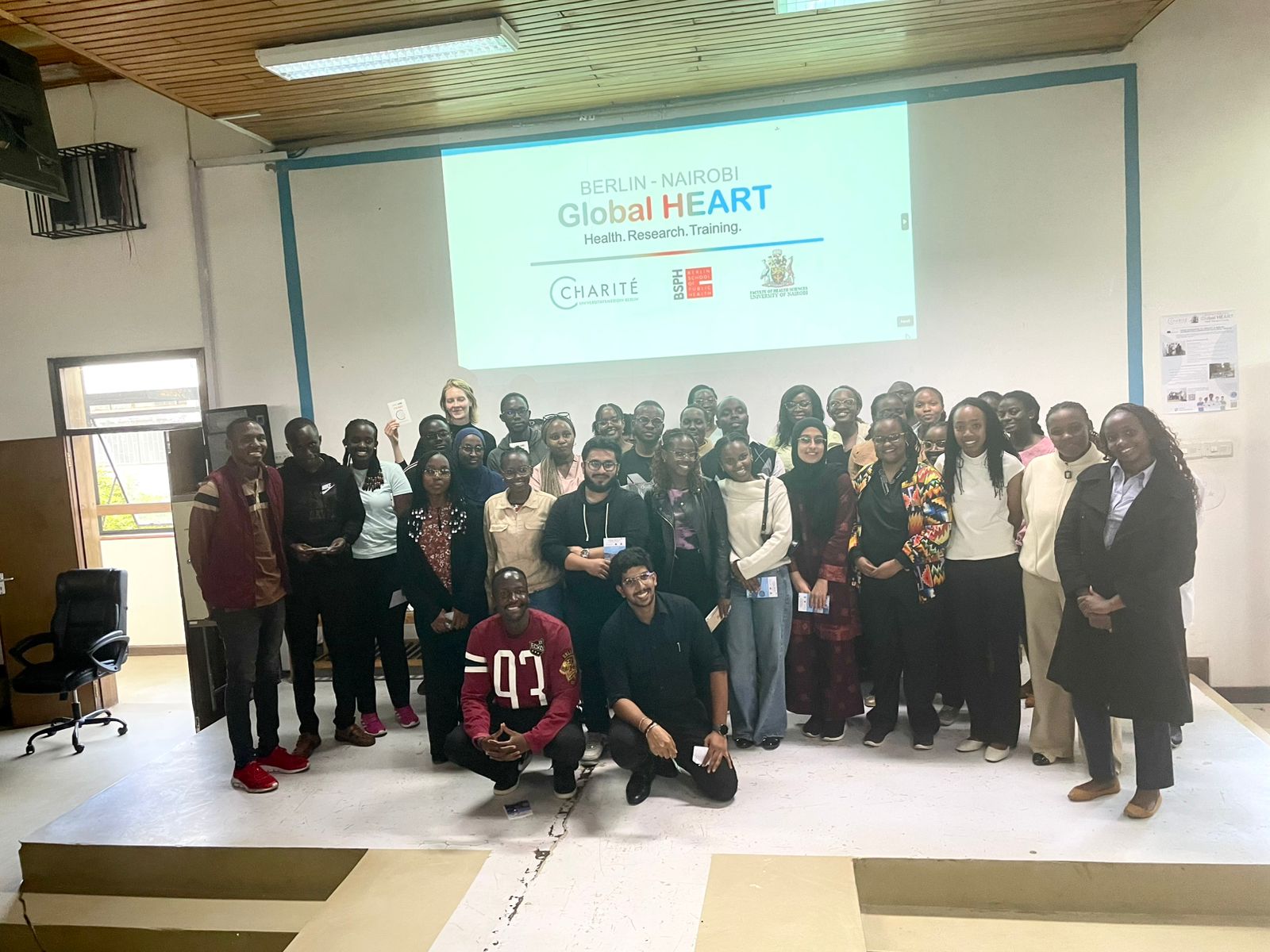
Global heart alumni and volunteers with FHS medical students after the session
There exists a fascinating contrast when comparing Geriatric care, the specialized medical attention for the elderly, in Kenya and Germany.
This distinction in medical care was discussed during a panel session hosted by the Faculty of Health Sciences (FHS) in collaboration with the Global Heart Berlin-Nairobi exchange program on 30th April 2026.
The panel consisting of alumni of the exchange program, a medical officer and a lecturer at the program’s partner Charité medical school, in Berlin delved into the stark difference surrounding the underserved medical practice of geriatrics in Kenya versus the thriving practice in Germany.
In Germany, a nation with a deeply entrenched social welfare system and a rapidly aging population, geriatric care is characterized by comprehensive, state-funded services. This includes a robust network of nursing homes, assisted living facilities, and home care services, all operating under strict regulations and quality standards.
In contrast, Kenya's approach to geriatric care is shaped by a different socio-economic landscape and cultural traditions.
While formal healthcare systems are developing, much of the care for the elderly still falls within the family unit, reflecting strong community ties and respect for elders. However, this informal system faces increasing strain due to urbanization and economic pressures.
Formal geriatric services are less widespread and often concentrated in urban centers, with accessibility and affordability being significant challenges for the majority of the population. This is a disparity since the older populations are mostly found in the rural areas.
Private facilities exist, but they are typically out of reach for most Kenyans, leading to a greater reliance on informal support networks and traditional remedies.
Speaking during the session, Panelist Stefanie Niewiem a German exchange student to Kenya pointed a finger to ignorance of geriatric care in the country.
“A lot of people do not know about dementia in Kenya and there exists few specialists, we then really have to look into our communities and teach families how to identify and care for dementia patients,” she added.
As Kenya's economy grows and its population ages, there is an increasing need to strengthen formal geriatric care structures. This could be through incorporating geriatrics into national health coverage like the Social Health Authority (SHA).
“Our health insurance system has not adapted to this change in home-based care or palliative care. This is a call to action to our ministry, there is no SHA for geriatrics, we do not need to wait for our old people to end stage diseases for us to take action,” said Dr MaryClare Wangare, a medical officer.
The discussions concluded that there is a need to improve geriatric care in Kenya to meet global standards through allocation of funds into the underserved practice. with the provision of accessible and quality healthcare for its elderly population.
Dr. Michael Nnaji from the Clinic for Geriatrics and Gerontology at Charité underscored the need for integration of geriatric medical studies into the medical school curriculum.
“Health care is a human right and everyone should have it, we have to treat geriatric health more seriously than we do especially in Sub-Saharan Africa, we can start by integrating geriatric care in the curriculum of our medical schools,” Dr. Nnaji emphasized in his address.
Balancing the preservation of cultural values with the provision of accessible and quality healthcare for the elderly population was also recommended.
Also speaking at the session were alumnus of the exchange program and a current student of the program in Germany who made presentations on their area of study and experiences with the program,
FHS Coordinator of exchange programs, Ms Beldine Ogutu urged students at FHS to take full advantage of such programs to expand the scope of their scholarly and professional reach.
- Log in to post comments


